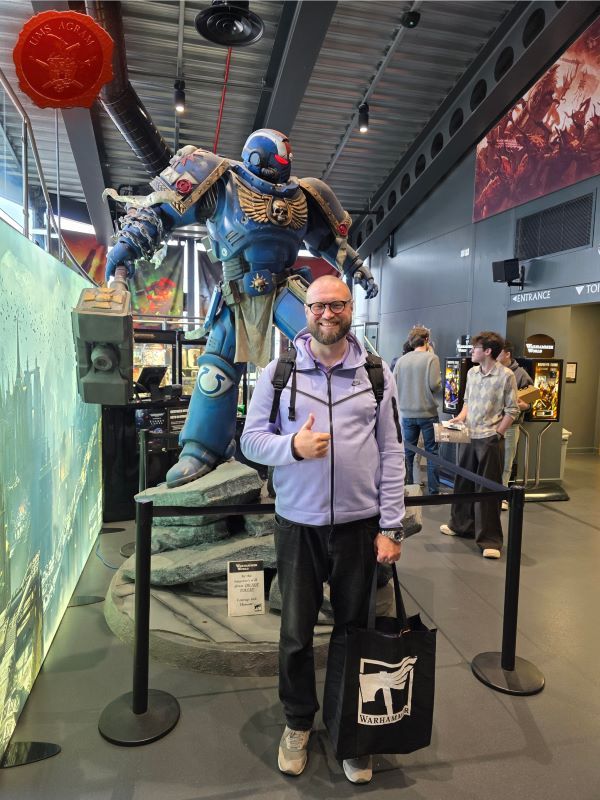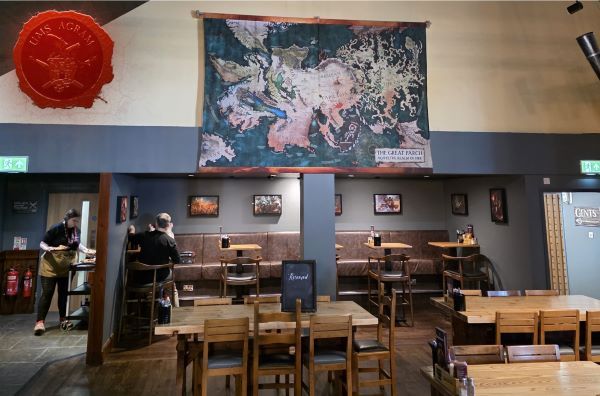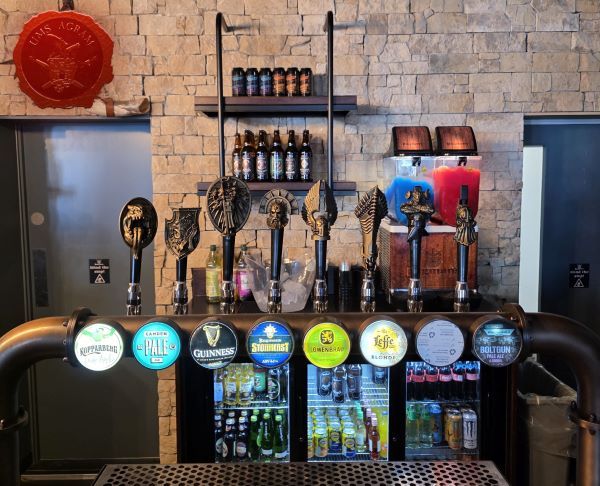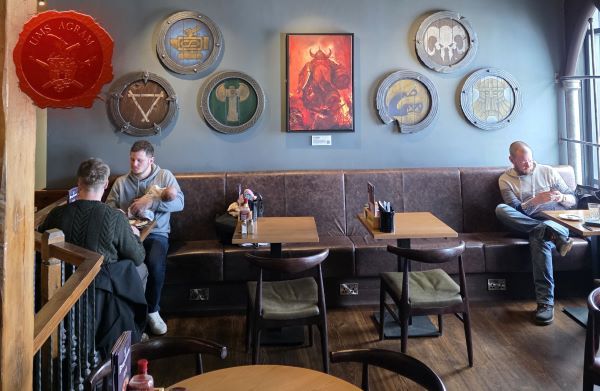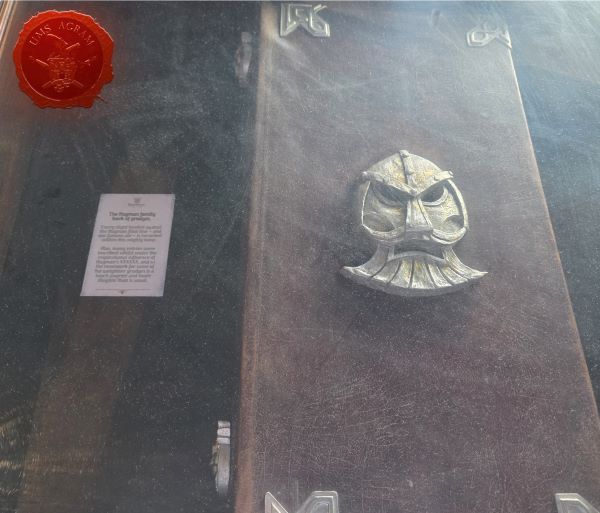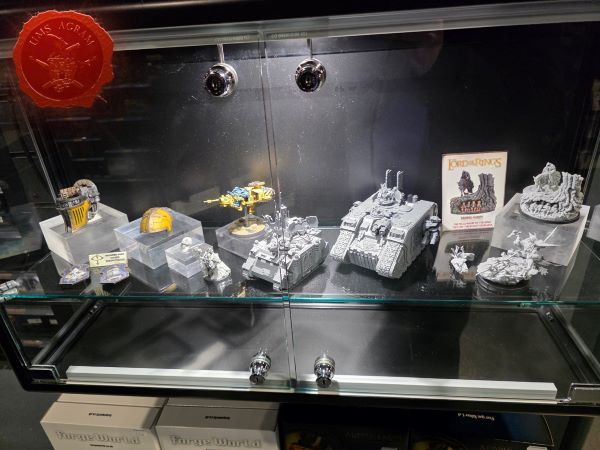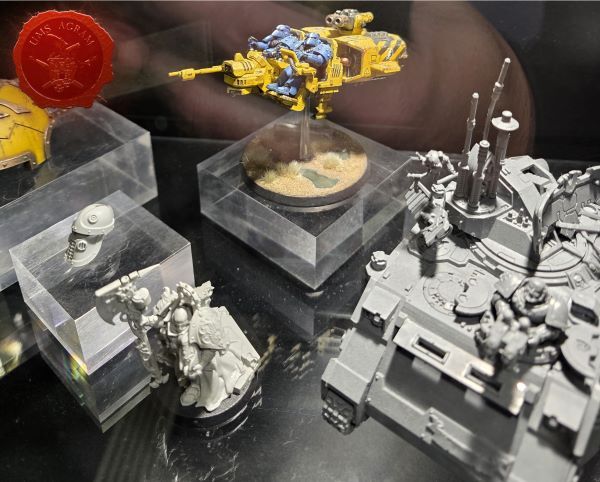
For any Warhammer hobbyist, a visit to Warhammer World in Nottingham is a pilgrimage of sorts. It is the epicenter of the entire Games Workshop culture - a combination of global corporate headquarters, visitor center, exhibition space, gaming hall, specialty store and themed bar, all gathered in one location. It should also be taken into account that the large gaming hall hosts Grand Tournaments for all games published by Games Workshop, and since our Ivan found himself in WHW on 18.4.2026. there was a WH40k tournament on the schedule, so the experience of the exhibition, Bugman Bar, WHW store, workshops, and gaming hall was also enhanced by the grand tournament that took place that day. This series follows his adventures…
2. Warhammer World
2.1. General Info
Warhammer World first opened its doors to the public in 1999. Over the years, it has been expanded and renovated several times, and today it functions as Games Workshop's global visitor center - a place where collectors, gamers, painters and fans from all over the world gather. The location is at Willow Road, Lenton, Nottingham NG7 2WS, and the complex itself shares space with Games Workshop's main headquarters.

It is important to note right away: entry to Warhammer World, the retail store, the Events Hall and Bugman's Bar is free. The only part of the complex that charges an entrance fee is the Exhibition Centre, which costs around GBP 8.50 (approx. EUR 9.80) for an adult. Opening hours are generally 10:00 - 18:00, with extended opening hours on Thursdays and Fridays (until 22:00) and Saturdays (until 20:00). The complex itself consists of four main parts.
2.2. Bugman's Bar
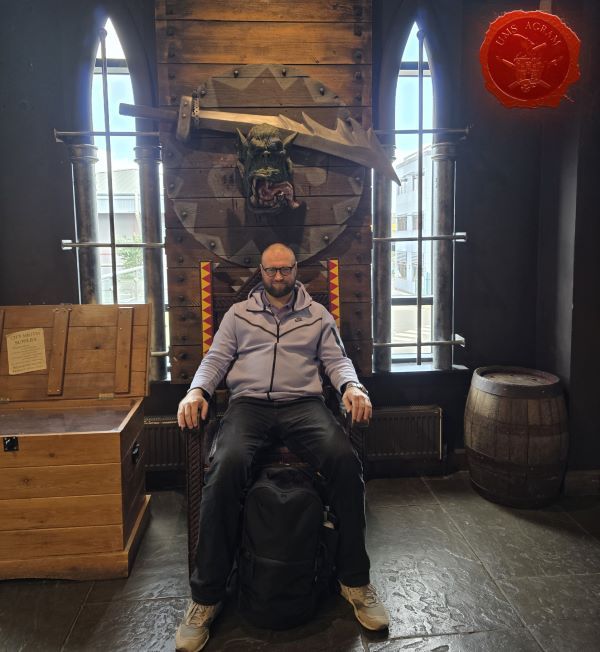
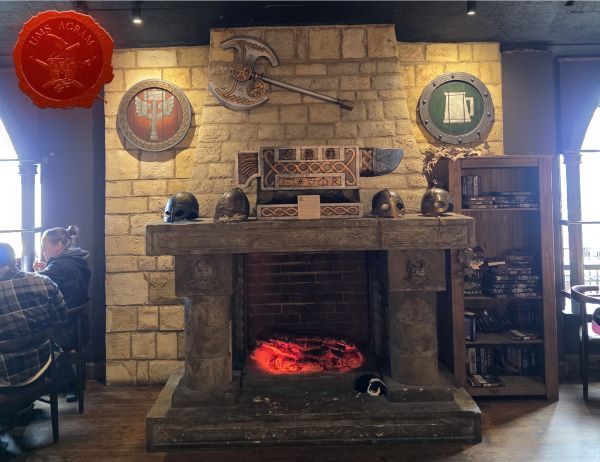
Bugman's Bar is a themed bar and restaurant named after Joseph Bugman, the famous dwarven brewer from the Warhammer: The Old World setting. The interior is consistently designed in the style of a dwarven fortress - stone elements, heavy wood, an anvil by the hearth, an Orc head mounted on the wall, and consistently themed lighting. It's a real "in-universe" experience that goes beyond the average shopping theme.
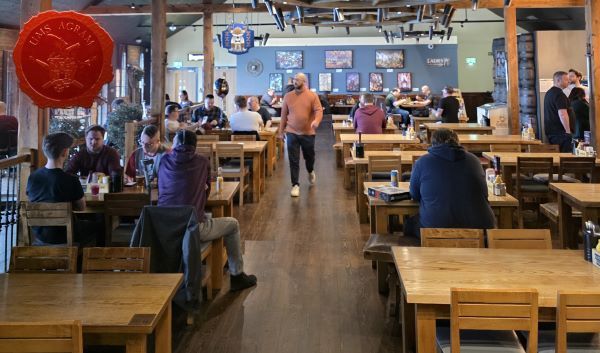
The food and drink offer is designed in the style of an English pub, with thematic names of dishes. The bar is a popular place to rest between games, socialize with other players and meet friends who gather in Warhammer World from different parts of the world. Food is served from morning until 18:00, while the bar is also open after that.
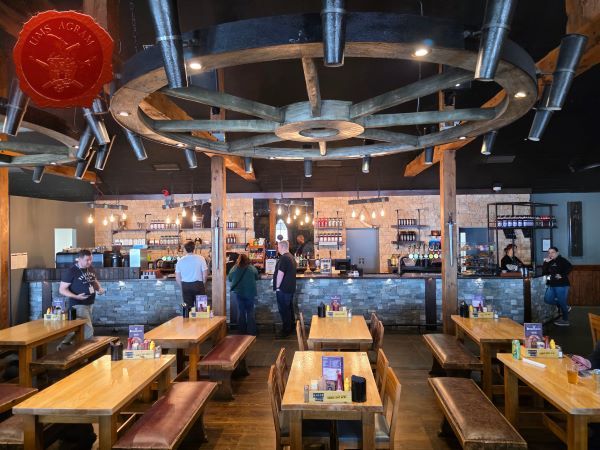
They have their own beers and spirits named after names from Games Workshop's own lore, and they also have an exclusive, which is a chicken drumstick eating contest with jalapeño sauce, and if you succeed in that, you get a title and a little pin badge. At the time we visited, it was unavailable due to a menu change, so that's another reason for us to visit again.
2.3. Retail Store
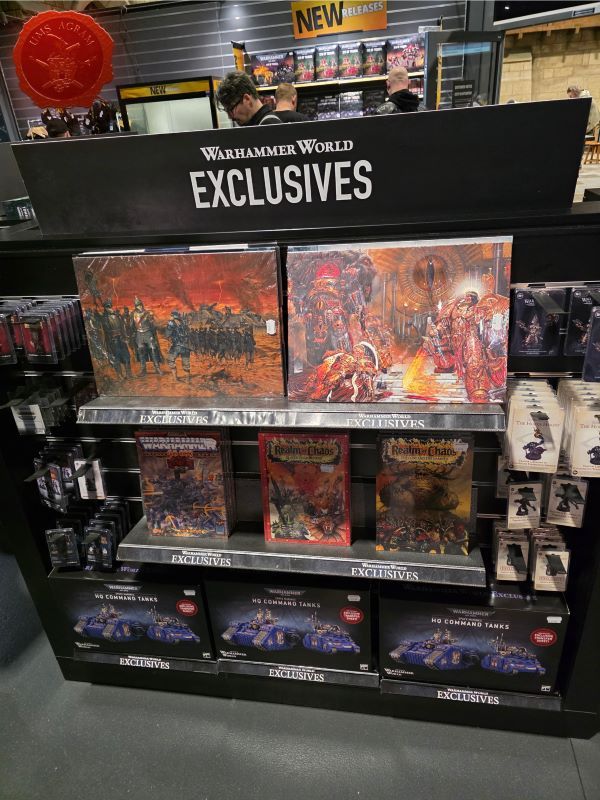
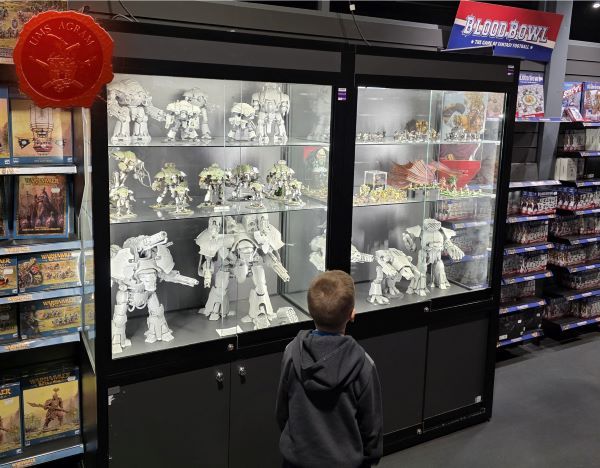
The Warhammer World store is significantly larger than the standard Warhammer stores found in European cities. The space is divided into two main units: one covers the complete range of Games Workshop figurines (Warhammer 40,000, Age of Sigmar, Middle-earth, Horus Heresy), while the other is dedicated to Forge World and its resin products. Special value is provided by the so-called "Warhammer World Exclusives" - models that can be purchased exclusively at this location or via their online shop. The offer also includes web-exclusive and event-exclusive models and limited editions that are sold out elsewhere. The store also has a Black Library department with books, as well as a corner for Warhammer Underworlds and other specialist products.
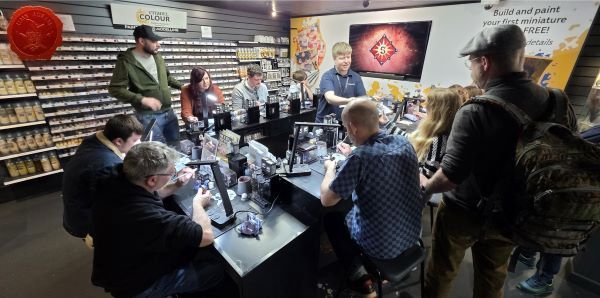
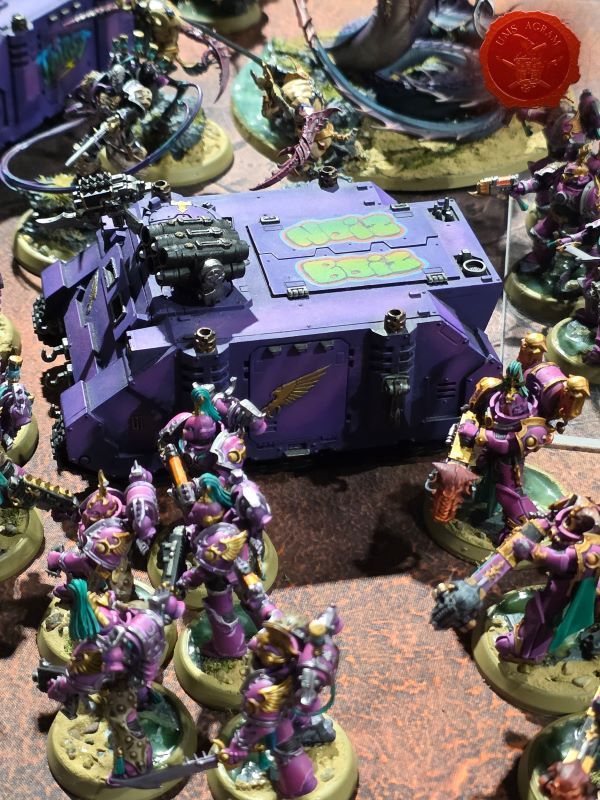
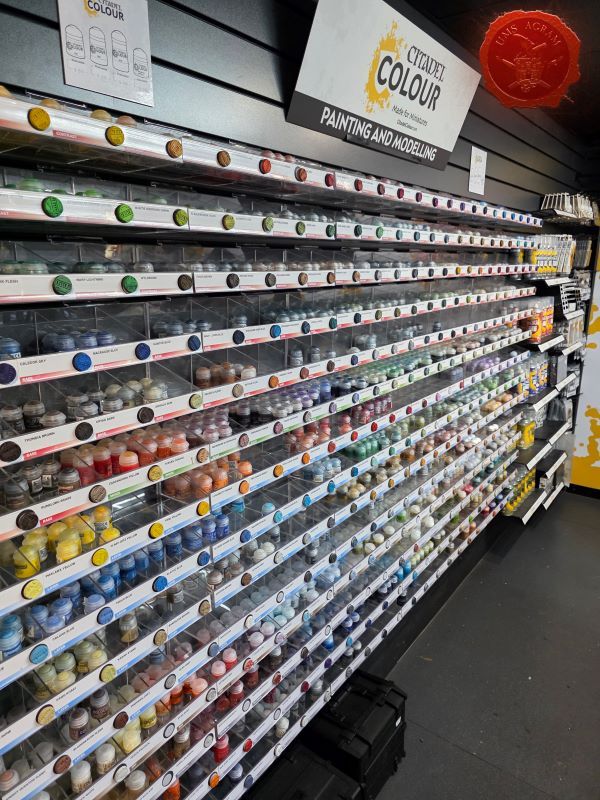
In the shop itself there is a wall with all the available Warhammer colors, as they are called after the last recent rebrand. Next to that wall there is a table with about 10 seats where, with guidance, they can be assembled and painted before the figures. These are usually figures of the month, two from each game. In the store itself I bought Space Marine HQ Command tanks, Space Marine HQ Command Tanks are a Warhammer World exclusive boxed set that contains two special vehicle variants - Land Raider Excelsior and Rhino Primaris - intended for a commanding role within the Space Marine Chapter. The set comes with an exclusive Command sprue and transfer sheet. Slightly tweaked two vehicles, with a different box, and will fit perfectly into the Ultramarine army I started.
2.4. Events Hall
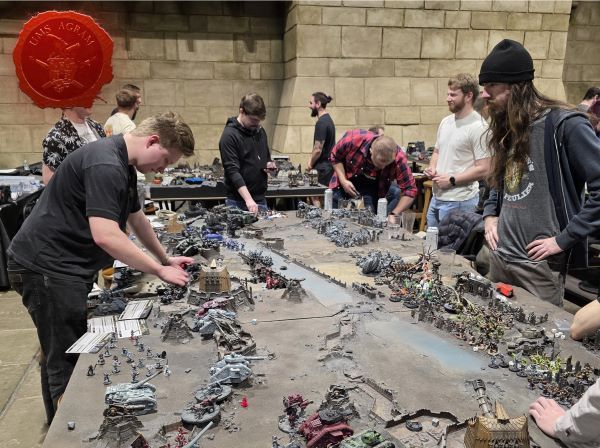
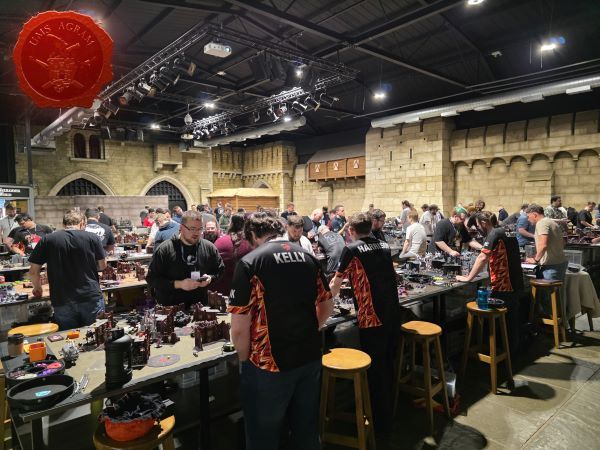
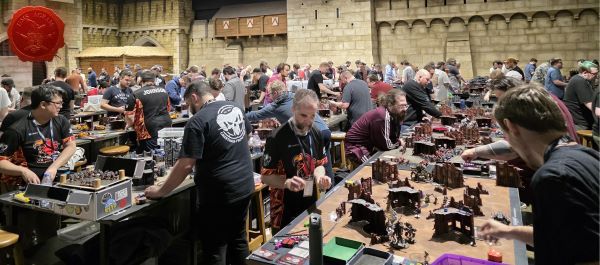
The Events Hall is the heart of the social life of the Warhammer World. It is a large hall themed as the Empire castle (The Empire from the Warhammer Fantasy / The Old World setting), with an impressive number of gaming tables. Some of the tables are standard tables equipped with excellently painted Age of Sigmar and Warhammer 40k terrain, while others are special, purpose-built tables for certain scenarios - e.g. a large table for Apocalypse games, themed tables for special campaigns, Necromunda areas and the like. The hall hosts many official Games Workshop events: competitive tournaments such as Throne of Skulls, narrative events, Forge World and Black Library Open Days, and various workshops. When there are no official events, visitors can reserve a table and play a game for free with prior notice.
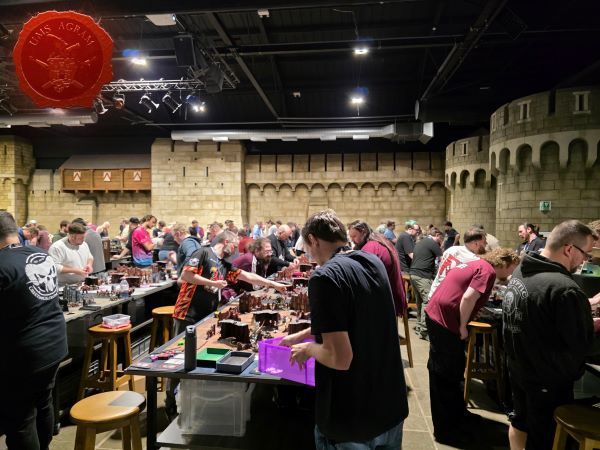
On the Saturday when we visited, the hall itself was the venue for the Warhammer 40k Grand Tournament, so that added to the excitement because the armies themselves were beautifully decorated, and the tournament was also very exciting.
On June 20-21 we attended 13th Trofeo San Giusto in Trieste, Italy.
It was held in Palazzo Vivante in the heart of Trieste and gathered miniature painters from Spain, Italy, France, England, Germany, Austria and I was the only participant in the miniature painting part of the competition from Croatia
As always we awarded the best of show prize as voted by our members. This time the prize went to Mr Alessandro Baialardo from Italy. And I managed to walk away with a gold, a silver and four bronze medals in Standard categories.
"
["content_hrv"]=>
string(7180) "
20. i 21. lipnja nastupili smo na 13. Trofeo San Giusto u Trstu u Italiji.
Natjecanje se održavalo u predivnoj palači Vivante u samom centru Trsta i okupilo je minijaturiste iz Španjolse, Italije, Francuske, Engleske, Njemačke, Austrije, a ja sam bio jedini na minijaturističkom dijelu natjecanja koji je branio boje Hrvatske.
Kao i uvijek na velikim natjecanjima, pripala mi je čast da dodijelim Best of Show nagradu po izboru članova UMS Agram. Ovoga puta, nagrada je otišla u ruke g. Alessandra Baialarda iz Italije koji je dobio naš ekskluzivni trofej Crne kraljice, monografiju o Udruzi te bocu Teranina. Na kraju uspio sam osvojiti zlato, srebro i četiri bronce u Standardnim kategorijama.
I recently was approached by the Historical Museum of Oslo to make three miniature dioramas for their exhibition MUMMY - a display of ancient Egyptian artefacts and mummies. Their requirements were that each of the three dioramas would portray a part of the life of one of the mummies from the exhibition, Dismut, a temple guardian’s daughter. Her Life, her Death and her Afterlife. In addition, they gave the maximum size of the display. This left me a lot of freedom for interpretation and to make the dioramas in my own way and style. In this article I’ll take you through part of my process for developing the three concepts. For a more detailed breakdown of the steps it took to complete the dioramas, see the videos.
My first focus was on the miniatures required. I searched online 3D-file shops to see what was already available. I knew this would be one of my limitations as there was no time or budget to 3D design all objects and characters required for all three dioramas. I found a pack of ancient Egyptian field workers, and so the Life diorama was created with this pack in mind - a tranquil scene by the Nile River, with workers harvesting wheat as Dismut observes from a higher vantage point. This diorama was also an opportunity to include some of the animals featured in the exhibition, so I found a cat and a mouse STL (and later a crocodile as well). As Dismut is not a famous pharaoh, there were obviously no STLs available of her, so I commissioned two 3D sculpts of her, giving me the chance to have her in the exact positions I needed for Life and Afterlife. In Death she would only appear as a mummified figure, easily available online.
I wanted the diorama to read from left to right, as the three dioramas would be displayed one next to the other, so as well as reading the specific Life diorama from left to right, I also wanted the entire display of all three dioramas to lead from left to right. I decided that from left to right the dioramas would also go from light to dark, Life being the lightest in tone and colour and Afterlife the darkest, reflecting the dioramas’ subjects. I decided on the scale for the entire display, around 50mm for humans, as this would be small enough to fit all the elements I needed, but large enough to fill up the dioramas with the amount of elements I found as STL’s and save me some time on not having to paint too many tiny details. I adjusted all STL’s to this scale, and found some realistic wheat plants online at the correct scale as well. And so the concept sketch for the Life diorama came together.
I knew that the Death diorama would be a burial ritual underground. I found a STL pack of several of the objects found in Tutankhamun’s grave, a burial ritual STL pack with two workers carrying a mummy and an ancient Egyptian priest. This would give me the scene. As the dioramas were going to have to be made as cubes, closed on all sides with walls, except for the front, as opposed to the open dioramas on display bases that we are used to, a part of planning each scene was also figuring out how to make the two sides and back panel a natural part of the dioramas. In Life this was an impossible task as no outdoor area is a cube, but I decided on making each side a rocky cliff and hoping the illusion of the scene would make the unaturally geometrical shape of the landscape become less visible. For Death my solution was a roller with Egyptian hieroglyphs. With this I could fill out each wall with historically accurate symbols and this way create interest in the surroundings of the scene as well. And for Afterlife, as this is already a “supernatural” scene, the walls would be bricks, extending the typical art found in Egyptian tombs portraying the Egyptian afterlife of Duat, into a 3D space. Generally I found a lot of inspiration and direction for this entire project from ancient Egyptian art and wall paintings.
The Afterlife diorama would have to have an Osiris character, the Egyptian God of the Dead, overseeing Dismut’s journey to Duat. As all STLs I could find of him had warrior poses, I instead commissioned a seated Osiris figure, as well as the scale that would measure Dismut’s heart against a feather, and thus if she is worthy of the Afterlife. I found a STL of Thoth, taking notes, and thought it suitable for the God judging the dead - in this case Dismut.
After the concepts were approved by the museum, so started a several months long process of getting the MDF walls for the cubes, cutting, carving and gluing XPS foam at the correct angles, sizes and shapes, painting around 40 miniature characters and objects, with airbrush and brush, creating and painting the landscapes, pouring epoxy resin for the Nile River as well as many other smaller and larger tasks. Of the many ideas that came during the making of the dioramas (not reflected in the concept sketches), one that I think especially contributed to the overall look of the final display, was the fact that I decided that each diorama would have its own main colour. Yellow for Life, sun and desert, Red for Death, underground an earthy, and Blue for Afterlife, cold and melancholic. This would differentiate the dioramas from each other even when being viewed from a distance, as well as give a natural progression from warm to cold, another way to add contrast and make the dioramas read in my preferred direction, from left to right. This was achieved most obviously through the choice of oil colours used to shade the three dioramas. Apart from that, the acrylic paints chosen are the same for all three dioramas, giving a cohesion of colour as well as being based on the available pigments they would have had at the time in Ancient Egypt - mineral pigments like lapis lazuli, red and ochre, soot for black, copper compounds for blue and green and synthetic pigments like Egyptian blue.
The final result is displayed here and will also be on display at Oslo’s Historical Museum for the foreseeable future. If you visit the city, make sure to stop by and have a look at the final display.
"
["content_hrv"]=>
string(8826) "
Nedavno me kontaktirao Povijesni muzej u Oslu da izradim tri minijaturne diorame za njihovu izložbu MUMIJA - prikaz drevnih egipatskih artefakata i mumija. Njihovi zahtjevi bili su da svaka od tri diorame prikazuje dio života jedne od mumija s izložbe, Dismut, kćeri čuvara hrama. Njezin život, smrt i zagrobni život. Osim toga, dali su maksimalnu veličinu prikaza. To mi je ostavilo puno slobode za interpretaciju i izradu diorama na moj vlastiti način i stil. U ovom članku provest ću vas kroz dio svog procesa razvoja triju koncepata. Za detaljniji pregled koraka potrebnih za dovršetak diorama pogledajte videozapise.
Moj prvi fokus bio je na potrebnim minijaturama. Pretražio sam online trgovine s 3D datotekama kako bih vidio što je već dostupno. Znao sam da će to biti jedno od mojih ograničenja jer nije bilo vremena ni proračuna za 3D dizajn svih predmeta i likova potrebnih za sve tri diorame. Pronašao sam skupinu drevnih egipatskih poljskih radnika, pa je diorama Život nastala imajući tu skupinu na umu - mirna scena uz rijeku Nil, s radnicima koji žanju pšenicu dok Dismut promatra s više točke. Ova diorama bila je i prilika za uključivanje nekih životinja predstavljenih na izložbi, pa sam pronašao mačku i miša u STL-u (a kasnije i krokodila). Budući da Dismut nije poznati faraon, očito nije bilo dostupnih STL-ova za nju, pa sam naručio dvije 3D skulpture, što mi je dalo priliku da je imam u točnim položajima koji su mi bili potrebni za Život i Zagrobni život. U Smrti bi se pojavila samo kao mumificirana figura, lako dostupna online.
Želio sam da se diorama čita slijeva nadesno, budući da bi se tri diorame prikazale jedna pored druge, pa sam, osim što se specifična diorama Života čita slijeva nadesno, također želio da cijeli prikaz sve tri diorame ide slijeva nadesno. Odlučio sam da će diorame slijeva nadesno ići od svijetlog prema tamnom, pri čemu će Život biti najsvjetliji po tonu i boji, a Zagrobni život najtamniji, odražavajući subjekte diorama. Odlučio sam se za mjerilo za cijeli prikaz, oko 50 mm za ljude, jer bi to bilo dovoljno malo da stanu svi potrebni elementi, ali dovoljno veliko da ispuni diorame količinom elemenata koje sam pronašao kao STL-ove i uštedi mi vrijeme jer ne bih morao slikati previše sitnih detalja. Prilagodio sam sve STL-ove ovom mjerilu i pronašao sam neke realistične biljke pšenice na internetu u ispravnom mjerilu. I tako je nastala konceptualna skica za dioramu Života.
Znao sam da će diorama Smrt biti pogrebni ritual pod zemljom. Pronašao sam STL paket nekoliko predmeta pronađenih u Tutankamonovoj grobnici, STL paket pogrebnog rituala s dva radnika koji nose mumiju i drevnim egipatskim svećenikom. To bi mi dalo scenu. Budući da su diorame morale biti izrađene kao kocke, zatvorene sa svih strana zidovima, osim sprijeda, za razliku od otvorenih diorama na izložbenim postoljima na koje smo navikli, dio planiranja svake scene bio je i smišljanje kako učiniti dvije strane i stražnju ploču prirodnim dijelom diorama. U filmu Život to je bio nemoguć zadatak jer nijedno vanjsko područje nije kocka, ali odlučio sam svaku stranu napraviti kao stjenovitu liticu i nadao se da će iluzija scene učiniti neprirodno geometrijski oblik krajolika manje vidljivim. Za Smrt moje rješenje bio je valjak s egipatskim hijeroglifima. S tim sam mogao ispuniti svaki zid povijesno točnim simbolima i na taj način stvoriti interes i za okolinu scene. A za Zagrobni život, budući da je ovo već „natprirodna“ scena, zidovi bi bili od cigli, proširujući tipičnu umjetnost pronađenu u egipatskim grobnicama koje prikazuju egipatski zagrobni život Duata u 3D prostor. Općenito sam pronašao mnogo inspiracije i smjernica za cijeli ovaj projekt u drevnoj egipatskoj umjetnosti i zidnim slikama.
Diorama zagrobnog života morala bi imati lik Ozirisa, egipatskog boga mrtvih, koji nadgleda Dismutovo putovanje u Duat. Budući da su svi STL-ovi koje sam mogao pronaći o njemu imali ratničke poze, umjesto toga sam naručio sjedeću figuru Ozirisa, kao i vagu koja bi mjerila Dismutovo srce u odnosu na pero, te time utvrdila je li dostojna zagrobnog života. Pronašao sam STL Thotha, bilježio i smatrao sam da je prikladan za Boga koji sudi mrtvima - u ovom slučaju Dismuta.
Nakon što je muzej odobrio koncepte, započeo je višemjesečni proces nabave MDF zidova za kocke, rezanja, rezbarenja i lijepljenja XPS pjene pod ispravnim kutovima, veličinama i oblicima, oslikavanja oko 40 minijaturnih likova i predmeta airbrushom i kistom, stvaranja i oslikavanja pejzaža, izlijevanja epoksidne smole za rijeku Nil, kao i mnogih drugih manjih i većih zadataka. Od mnogih ideja koje su se pojavile tijekom izrade diorama (koje nisu odražene u skicama koncepta), jedna za koju mislim da je posebno doprinijela ukupnom izgledu konačnog prikaza bila je činjenica da sam odlučio da će svaka diorama imati svoju glavnu boju. Žuta za život, sunce i pustinju, crvena za smrt, podzemlje i zemljanost, a plava za zagrobni život, hladnu i melankoličnu. To bi razlikovalo diorame jednu od druge čak i kada se gledaju iz daljine, kao i dalo prirodan prijelaz od toplog prema hladnom, još jedan način dodavanja kontrasta i da se diorame čitaju u mom željenom smjeru, slijeva nadesno. To je najočitije postignuto odabirom uljanih boja korištenih za sjenčanje triju diorama. Osim toga, akrilne boje odabrane su iste za sve tri diorame, što daje koheziju boja, a ujedno se temelji na dostupnim pigmentima koje su imali u to vrijeme u drevnom Egiptu - mineralni pigmenti poput lapis lazulija, crvene i oker boje, čađa za crnu, spojevi bakra za plavu i zelenu te sintetički pigmenti poput egipatske plave.
Konačni rezultat je ovdje izložen i bit će izložen u Povijesnom muzeju u Oslu u doglednoj budućnosti. Ako posjetite grad, svakako navratite i pogledajte konačni postav.
On 09-10.05.2026. we held a new weekend miniature painting workshop. This time it was the turn of a dwarf in 75mm scale.
The workshop was held over two days (a whole weekend) and the participants painted a 75mm miniature dwarf. The focus of these lectures was painting various textures - metal, human skin, textiles and leather. Water-based acrylic paints were used in the workshop. For this purpose, the workshop leader, Ivan Knezović, chose a 75mm miniature dwarf from Durgin Paint Forge, sculpted by Carlos Perez Bugedo. The lectures were adapted so that the leader devotes equal time to all participants and can be adapted to all categories of miniaturists (from beginners to slightly more advanced).
The workshop took place as follows:
First, the lecturer sits at his desk and explains and demonstrates each step in painting a miniature/model on his specimen. His work is displayed on a screen via a camera and projector, which the participants listen to, watch, and ask questions about.
Then, the participants sit at their desks and apply the knowledge they have gained. The facilitator circulates among the participants and checks how each participant is doing. This way, he or she can adapt to each participant individually.
The workshop will include the following thematic units:
1. NMM (Non metallic metal)
2. Reflections of ambient colors on metal
3. Steel / gold
4. Face painting (male)
5. Adding vibrancy to the face (filters)
6. Extracting textures from fabric, metal and leather
09-10.05.2026. smo održali novu vikend Radionicu bojanja minijatura. Ovoga puta na redu je bio patuljak u 75mm mjerilu.
Radionica se provodila kroz dva dana (cijeli vikend) i polaznici su bojali 75mm minijaturu patuljka. Fokus ovih predavanja bilo je bojenje raznih tekstura – od metala, ljudske kože, tekstila i kože (leather). U sklopu radionice korištene su akrilne boje na bazi vode. U tu svrhu, voditelj radionice, Ivan Knezović, izabrao je 75 mm minijaturu patuljka tvrtke Durgin Paint Forge, koju je sculptao Carlos Perez Bugedo. Predavanja su prilagođena tako da voditelj posveti jednako vrijeme svim polaznicima i može se prilagoditi svim kategorijama minijaturista (od početnika do malo naprednijih).
Radionica se odvijala na sljedeći način:
Prvo, predavač sjedi za svojim stolom te objašnjava i demonstrira pojedini korak u bojanju minijature/makete na svojem primjerku. Njegov rad se preko kamere i projektora prikazuje na platnu što polaznici slušaju, gledaju, ali i postavljaju pitanja.
Potom, polaznici sjedaju za svoje stolove i primjenjuju stečeno znanje. Voditelj kruži između polaznika i provjerava kako svakom polazniku ide. Na taj način, može se prilagoditi svakom polazniku ponaosob.
Radionica će uključivati sljedeće tematske cjeline:
1. NMM (Non metallic metal)
2. Refleksije boja iz okoline na metalu
3. Čelik / zlato
4. Bojanje lica (muškog)
5. Dodavanje živosti na lice (filteri)
6. Izvlačenje tekstura tkanine, metala i kože (leather)