WW2 Monastery Scene – Reflections on the Diorama Composition
In this series of articles, I will follow the creation of a diorama of a monastery set at the end of the Second World War when the Americans had already invaded Germany, which shows a company in the middle of a rest. These articles do not actually follow the chronological creation, but are arranged according to some thematic units.
After reading the title, you're probably wondering what this guy is going to be talking about? Rightfully so. Probably, even I would not understand what the writer wants to say if I read such a title. Probably some philosophy. And yes, you are right. But there is a reason why I am writing this text, so please be patient and give me a chance.
Namely, judging by a large number, and participating in an even larger number of competitions, I noticed that a lot of modelers have problems with the believability of the story of their diorama. Either they get lost in a pile of details (a kind of horror vacui), or the scene is much too big for the story it's telling (the exact opposite of horror vacui). Also, in a large number of works there is no "good" interaction between the actors or between the actors and the scene. Well, it all looks like Scotty just beamed them up in the middle of the scene.
This prompted me to write this article to describe the creative process of creating the diorama and its transformation as I completed individual elements. The fact that when I wrote previous articles that I found a sufficient number of photos of the entire diorama with elements in various stages of the project also helped.
How did I come up with the idea for this diorama? For my birthday, Mario and Seb gave me two models. One was an ambulance Jeep (Mario) and the other an American armored Greyhound (Seb). This prompted me to plan a diorama that will contain those two models. Soon the FB feed reminded me of a scene from RT Diorama that seemed perfect to me. A jeep coming into the square, and an armored personnel carrier between two buildings peeking out of the rubble with half the building collapsed on top of it. Fantastic! Buy Marko. When the package arrived, unfortunately, Seb's armored car didn't fit between the two buildings, so he was out of the game. At the Zagreb Cup, I visited the Hobby Chest stand and found the SDKFZ 223 model there. Darko allowed me to open the box and measure the width of the vehicle. It turned out to be 5mm narrower than the passage. Fantastic. What's even better is that I found two sets of Americans with him just to complete my diorama.
The figures I got were: two lying down, two lying down and playing cards, one sitting on his helmet reading something (newspaper), one standing and looking into the distance, one Jeep driver and one riding in a Jeep. Everything is super usable except maybe the one that drives. I scattered the team around the field as it seemed to me that it might work.
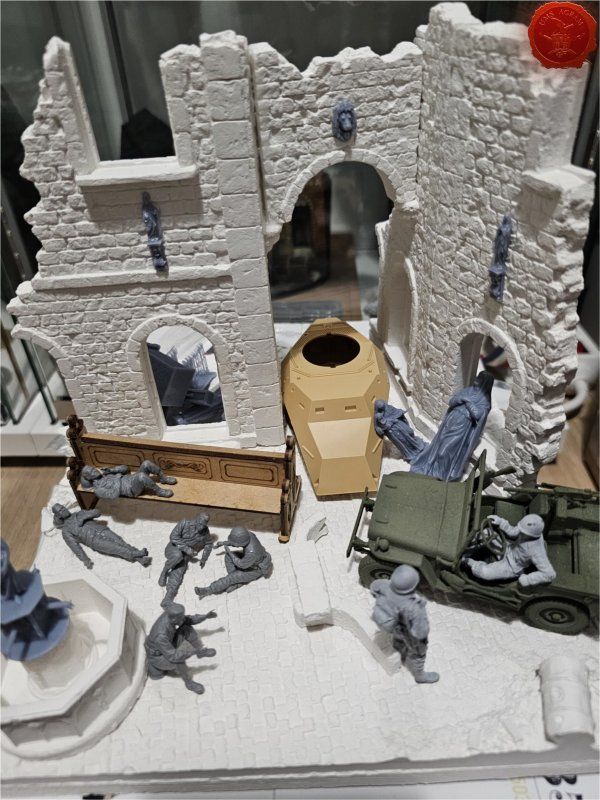
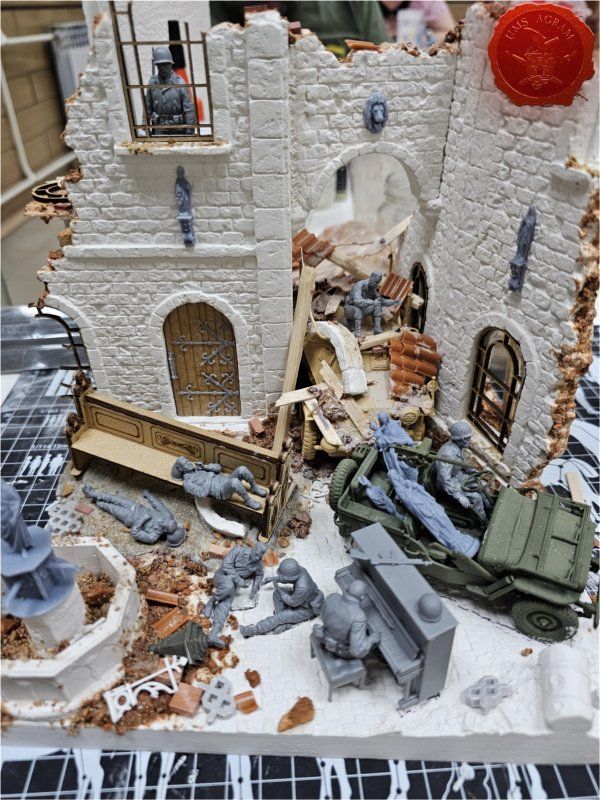
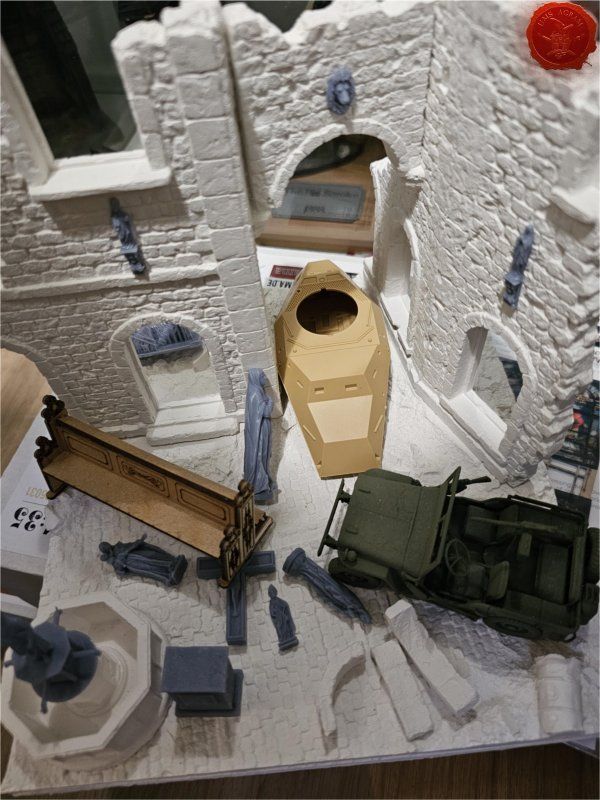
In the meantime, I had the idea to put together a MiniArt piano and set it up to play. With a bit of conversion (cutting and hand rotation) I succeeded in my plan. This required a new arrangement of pieces. The one standing will be on the hood of the battleship and will be looking towards the back of the diorama (down the road), and the others will be concentrated around the fountain. The statues will be part of the ruins.
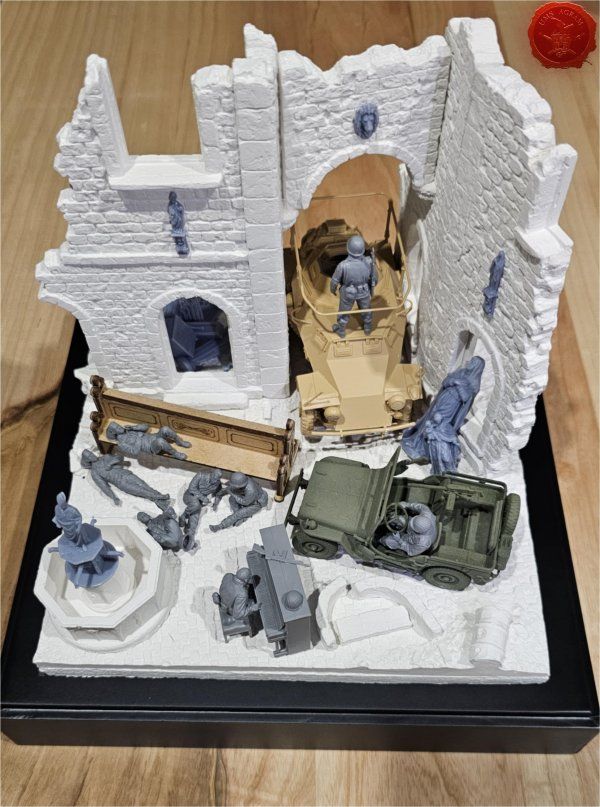
At one of the hobby corners on Wednesdays, someone from the team commented that my first floor was a little empty. I dismissed the idea, but it kept bugging me. Until I realized he was right. A series of figures followed and the only one that passed was the one standing and looking into the distance. But that makes me lose crew interaction with the wreck of the battleship. So I tested how it would look like the one reading the newspaper on it. I was not unhappy with the result. The bench, on the other hand, looked too big, so I decided to fill the part not occupied by the soldier with smaller statues. They were taken out and prepared for "liberation". Let's say the Jeep driver arrives to pick them up.
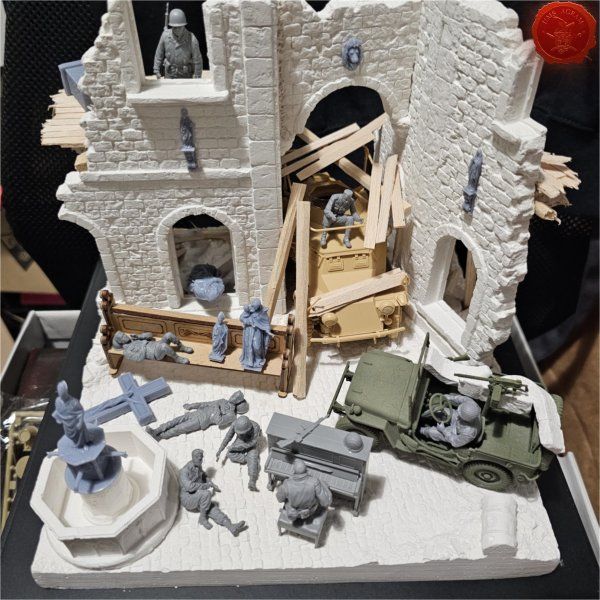
By setting the texture, the story more or less remained the same. There I had to position the bench as well as one lying down to fit into the volume added with DAS clay.
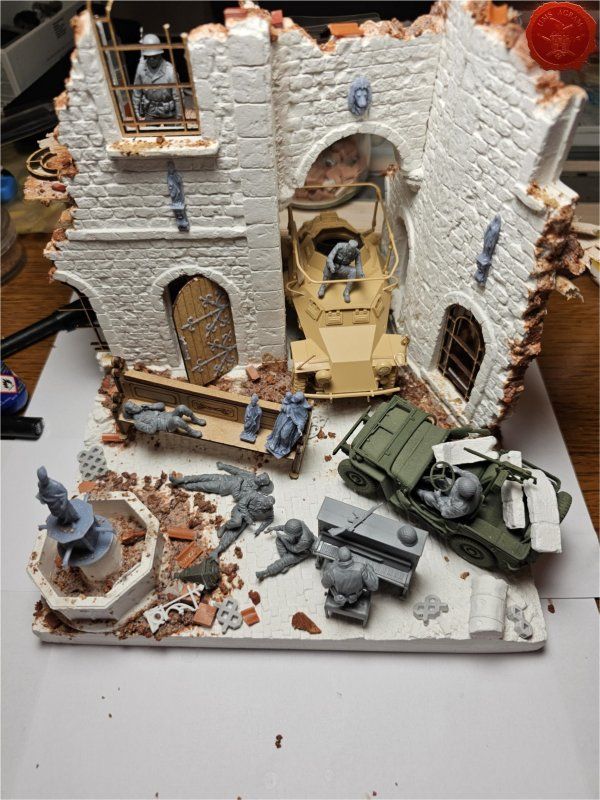
In the meantime, I assembled the ambulance Jeep (the one in the pictures before was a "placeholder" from another diorama). The ambulance Jeep has a scalameria carrying a stretcher. This gave me the idea to add statues to the stretcher. But it also turned Jeep in the other direction. He leaves with the statues.
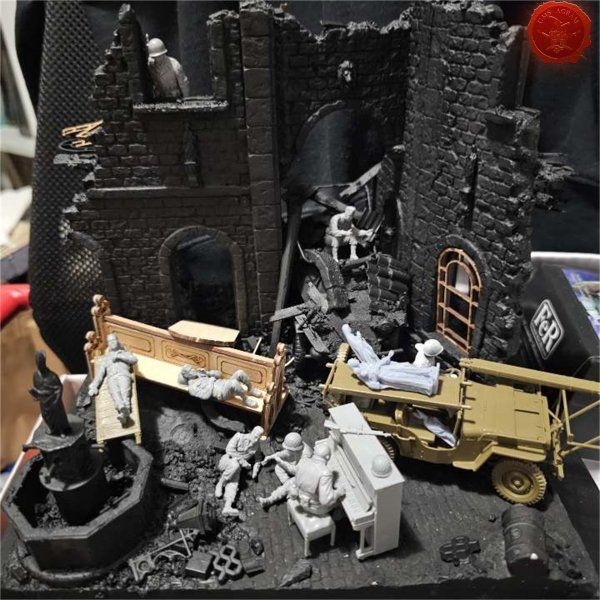
I was finally satisfied with the story. In fact, the turning of the Jeep and the lack of interaction of the rest of the team with the driver who releases the statues gives the impression of alienation and lack of morale in extreme conditions. Everyone does their own thing even though they are together in a small space.
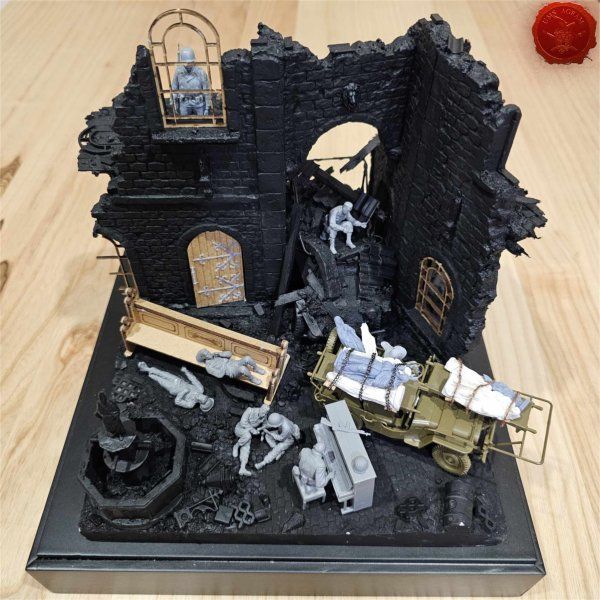
I hope that this journey through the making of a diorama gave you at least a little insight into the process of diorama composition. Each part must make sense and be clear about why it is there. Next time, we start with painting.
Latest articles
- Lizardmen Sauropod – part 1 Mario Grgurev, 19th October 2026
- Agram Group Build #7 – Amon Hen, pt.5 Krunoslav Belinić, 15th October 2026
- Agram Group Build #7 – Amon Hen, pt.4 Marko Paunović, 8th October 2026
- Agram Group Build #7 – Amon Hen, pt.3 Krunoslav Belinić, 1nd October 2026
- Agram Group Build #7 – Amon Hen, pt.2 Marko Paunović, 24th September 2026




Latest battle-reports
- Kill Team - Blooded vs. Vespid Stingwings 28th February 2025, GW - Warhammer 40.000, and Antoni Pastuović (Imperial Guard)
- 22nd April 2022, GW - Warhammer 40.000, Borna Pleše (Space Marines) and Kristijan Kliska (Tau Empire)
- 17th November 2021, GW - Warhammer 40.000, and Nino Marasović (Space Marines)